According to its mayor, Los Angeles will be off coal by 2025.
Reported by KPCC Southern California Public Radio, Los Angeles mayor Antonio Villaraigosa will be "signing papers" in the coming weeks that will wean the city from coal-fired power within the 12 years.
About 39 percent of L.A.'s power now comes from coal-fired plants. The mayor announced the news this week at an University of California Los Angeles (UCLA) event on green cities, sponsored by UCLA's Institute of the Environment and Sustainability.
The audience greeted Villaraigosa's news with surprise. The city's coal habit has been the topic of a significant amount of environmental campaigning in recent months.
Of the coal fired power in the Los Angeles Department of Water and Power's grid, two thirds comes from the 1,900 megawatt Intermountain Power Plant in Delta, Utah, while the remainder is generated by the 2,250-megawatt Navajo Generating Station in northern Arizona.
Wednesday, February 27, 2013
Wednesday, February 13, 2013
Solar Leases Make Residential Solar Power More Affordable
Solar leases are making residential solar energy more affordable for many homeowners across the United States.
The high, up-front cost of solar panel installation causes many people to reconsider utilizing this renewable energy source, despite the fact that it not only lessens monthly electricity bills but also reduces our carbon footprint.
However, the new option of "solar leases" are a great alternative and are expected to lead to more installations nationwide. These leases allow a homeowners to pay either very little or no money down to have solar panels installed on the roofs of their homes. The catch here is that instead of buying solar panels, the homeowner leases them from a solar lease company.
Instead of paying the sometimes massive upfront cost, homeowners pay a monthly fee for using the electricity generated by the solar panels. Homeowners would then typically sign a long-term contract (approximately 15 to 20 years) with the solar lease companies that 1) pay for solar equipment and the installation and 2) make sure the solar panels function properly and perform general maintenance.
The high, up-front cost of solar panel installation causes many people to reconsider utilizing this renewable energy source, despite the fact that it not only lessens monthly electricity bills but also reduces our carbon footprint.
However, the new option of "solar leases" are a great alternative and are expected to lead to more installations nationwide. These leases allow a homeowners to pay either very little or no money down to have solar panels installed on the roofs of their homes. The catch here is that instead of buying solar panels, the homeowner leases them from a solar lease company.
Instead of paying the sometimes massive upfront cost, homeowners pay a monthly fee for using the electricity generated by the solar panels. Homeowners would then typically sign a long-term contract (approximately 15 to 20 years) with the solar lease companies that 1) pay for solar equipment and the installation and 2) make sure the solar panels function properly and perform general maintenance.
Friday, February 8, 2013
Renewable Energy Pushes for Updated Financing Options
Green energy industries like wind and solar cannot compete
with fossil fuels without hefty tax breaks intended especially for them. They
have been telling Congress this for years, but now they are upping their plea as
opposition for renewable energy subsidies are running high among many
Republicans.
Although White House officials say they see expanding REITs
and MLP’s as keeping with their larger clean energy goals, they are more
focused on eliminating direct subsidies and loopholes for fossil fuels and
establishing a permanent production tax credit for renewables.
According to the New York Times, the renewable energy
industries are now asking Washington to allow wind and solar companies to qualify
for some of the tax advantages that are used by the oil, gas and real estate
industries to raise money from investors.
The industries are looking to two investment structures — the master limited partnership and the real estate investment trust — to help make financing easier and cheaper. It is estimated that opening them up to renewable companies could cut the cost of their energy by one third.
As with conventional power plants, the cost of building wind and solar farms can run into the billions of dollars, involving elaborate planning, construction and equipment.
Wind and other green energy technologies have become cheaper, but the cost of investing has stayed relatively high. And last month, 31 lawmakers, including Senators Lisa Murkowski of Alaska and Jerry Moran of Kansas and Representative Ted Poe of Texas, sent a letter to President Obama urging him to support the changes. All three are Republicans supported by gas and oil interests, according to OpenSecrets.org.
Allowing solar and wind firms to use a tax break offered to oil and gas companies fits into the worldview of an "all-of-the-above" energy strategy.
Under current law, the federal government offers renewable
energy companies a generous tax credit against their income. But since few of
them make enough profit to use the credits, they need to find investors —
typically companies seeking to shield nonenergy profit from taxes — to take
advantage of the breaks. Because the pool of such prospects is small, the
investors that do jump in, like Google, have been able to command high rates of
return.
By using a REIT or MLP. for renewable energy projects, the
companies could reach a broader range of investors. MLP’s and REITs are
similar in that they do not pay corporate income taxes, passing most of their
income to their investors, who then pay taxes on it at their own personal
rates. Both are also often traded publicly like stock, giving companies access
to a much larger pool of investors who are willing to take a lower rate of
return, according to tax lawyers and experts.
There are differences in the ways the two investment
vehicles work. REITs, which are typically used to bundle groups of apartments
or office buildings into tradable investments, cannot take advantage of tax
credits. So a solar REIT would not be able to use the 30 percent investment tax
credit still available to such projects through 2016. MLP.’s can use tax
credits, but the partnerships are more complicated, tax lawyers said, which
might keep investors away.
Friday, January 25, 2013
Obama's 2nd Term Push for Climate
President Barack Obama pledged in his inaugural address Monday to respond to the threat of climate change, saying the "failure to do so would betray our children and future generations."
By singling out climate change for several lines of his speech, he is taking on an issue that he acknowledges was often overlooked during his first term and setting up a confrontation with congressional Republicans who have opposed legislative efforts to curb global warming.
Reuter's reported that Obama will renew his push to spur investment in renewable energy projects that create jobs as a key part of his second-term strategy for tackling climate change, according to a top White House policy adviser.
During his second term, Obama won't have the $90 billion in economic stimulus funds that his administration had pumped into clean energy and "green jobs" projects during the first term. Instead, Obama wants to see "targeted and smart" investments in research and demonstration projects, and will also use the upcoming corporate tax reform process to try to "level the playing field" for renewable forms of energy, said Brian Deese, deputy director of the National Economic Council.
Obama has continued to argue that the United States cannot fall behind in a global clean energy race dominated by countries like China, South Korea and Germany, which heavily subsidize their domestic industries. "Our political system and our private sector are never going to operate in the way that some of those countries operate to strategically support targeted industries and go all-in in that way," Deese told a National Journal/The Atlantic event on energy innovation.
While Obama's inauguration words attracted a lot of attention, what came next in the speech was also important, Deese said - Obama's contention that the nation must use more "sustainable energy sources" to maintain its "economic vitality" as well as to protect the environment.
"We cannot cede to other nations the technology that will power new jobs and new industries, we must claim its promise," Obama said.
The White House is realistic about the slim chances of advancing comprehensive climate legislation in Congress, where many Republicans are staunchly opposed. Instead, Deese said the administration will look for ways to use other types of legislation to accomplish clean energy goals, including upcoming efforts to overhaul the tax code.
Obama recently pushed for an extension of the wind production tax credit and other clean energy tax credits as part of the "fiscal cliff" deal with Congress. Tax breaks for traditional fossil fuel production have long been enshrined in the U.S. tax code, Deese said. "One of the things the president has talked about is ... at a minimum, we should have a level playing field" for renewable energy.
The President also wants to explore "targeted and smart investments to help catalyze renewable energy technologies" that can lead to more U.S. manufacturing jobs, said Deese, adding that projects to make buildings become more energy efficient is another area of promise. He said Obama still would like to see Congress pass a "clean energy standard" with annual targets for electricity from clean sources that would allow utilities to decide what type of renewable power source would best fill the quota.
Obama also may take actions that don't require congressional approval or spending, such as the increase in fuel economy standards set during his first term that will cut carbon pollution and fossil fuel use dramatically over 25 years.
By singling out climate change for several lines of his speech, he is taking on an issue that he acknowledges was often overlooked during his first term and setting up a confrontation with congressional Republicans who have opposed legislative efforts to curb global warming.
Reuter's reported that Obama will renew his push to spur investment in renewable energy projects that create jobs as a key part of his second-term strategy for tackling climate change, according to a top White House policy adviser.
During his second term, Obama won't have the $90 billion in economic stimulus funds that his administration had pumped into clean energy and "green jobs" projects during the first term. Instead, Obama wants to see "targeted and smart" investments in research and demonstration projects, and will also use the upcoming corporate tax reform process to try to "level the playing field" for renewable forms of energy, said Brian Deese, deputy director of the National Economic Council.
Obama has continued to argue that the United States cannot fall behind in a global clean energy race dominated by countries like China, South Korea and Germany, which heavily subsidize their domestic industries. "Our political system and our private sector are never going to operate in the way that some of those countries operate to strategically support targeted industries and go all-in in that way," Deese told a National Journal/The Atlantic event on energy innovation.
While Obama's inauguration words attracted a lot of attention, what came next in the speech was also important, Deese said - Obama's contention that the nation must use more "sustainable energy sources" to maintain its "economic vitality" as well as to protect the environment.
"We cannot cede to other nations the technology that will power new jobs and new industries, we must claim its promise," Obama said.
The White House is realistic about the slim chances of advancing comprehensive climate legislation in Congress, where many Republicans are staunchly opposed. Instead, Deese said the administration will look for ways to use other types of legislation to accomplish clean energy goals, including upcoming efforts to overhaul the tax code.
Obama recently pushed for an extension of the wind production tax credit and other clean energy tax credits as part of the "fiscal cliff" deal with Congress. Tax breaks for traditional fossil fuel production have long been enshrined in the U.S. tax code, Deese said. "One of the things the president has talked about is ... at a minimum, we should have a level playing field" for renewable energy.
The President also wants to explore "targeted and smart investments to help catalyze renewable energy technologies" that can lead to more U.S. manufacturing jobs, said Deese, adding that projects to make buildings become more energy efficient is another area of promise. He said Obama still would like to see Congress pass a "clean energy standard" with annual targets for electricity from clean sources that would allow utilities to decide what type of renewable power source would best fill the quota.
Obama also may take actions that don't require congressional approval or spending, such as the increase in fuel economy standards set during his first term that will cut carbon pollution and fossil fuel use dramatically over 25 years.
Tuesday, January 15, 2013
Cost of Solar Power Reduced with Federal Tax Credit
Solar power is a great source of renewable energy. It doesn't add pollution to the atmosphere and reduces the dependence and use of coal and other fossil fuels, allowing individuals to reduce their carbon footprint.
However, the cost of solar power is five times higher than from coal and other sources and the pay back period is many years, leading many Americans to stay away from using solar. To encourage Americans to use solar power, there are federal, state, local and utility incentives and rebates for solar energy systems.
These include tax credits, tax deductions, property tax relief, purchase incentives (rebates), production incentives, and more. More specifically, the Environmental Protection Agency (EPA) and the Department of Energy offers tax credits for solar-powered appliances.
Although rebates and incentives can vary from state to state, there is an overarching federal tax credit available for residential installations for solar panels. The Internal Revenue Service expanded the federal tax credit for solar power, making it so that systems installed between Jan. 1, 2009, and Dec. 31, 2016, are eligible for a tax credit equal to 30% of the cost. To qualify, the system must supply electricity to a residence and meet local building codes. This tax credit is only for residential purposes. Corporate deductions, exemptions, and tax credits are available the commercial, industrial, and government entities.
Solar tax exemptions, including both property and sales tax exemptions, are provided by state and local governments to help lower the costs of owning solar energy property. For both business and residential solar systems, there are also federal grant and loan programs. Several are backed by the US Department of Agriculture (USDA). These loans and grants assist people to install solar power panels.
In addition to tax credits and rebates, a typical residential solar system should reduce electricity bills by 25 percent to 50 percent, according to the Solar Energy Industries Association. The average household pays about $110 a month for electricity, according to the Energy Department, so a solar-panel system should save you between $300 and $600 a year. The payback period will vary greatly depending on how sunny it is where you live, the size of your system, the cost of your system, and future swings in local electricity costs. That being said, it could take anywhere from 6 to 18 years to get paid back for your solar panels.
When it comes to a particular state, things vary. In general, systems are cheaper in places like Arizona and California, where electricity is expensive, sunshine is plentiful, and solar has gained wider acceptance.
For example, the California Solar Initiative (CSI) allows residents to hire a certified a San Diego Solar installer to not only install the solar panels in San Diego, but also handle the CSI process for rebates on installation. Once the system is up and running, a resident can then claim their incentive (or payment). Residents can do this on top of their federal tax credit, getting the most cost effective solar panels possible.
Although not every state is as solar-forward thinking as California, each has some sort of incentive, tax credit, or rebate available. Search the Database of State Incentives for Renewables & Efficiency for state and local incentives in your area/
However, the cost of solar power is five times higher than from coal and other sources and the pay back period is many years, leading many Americans to stay away from using solar. To encourage Americans to use solar power, there are federal, state, local and utility incentives and rebates for solar energy systems.
These include tax credits, tax deductions, property tax relief, purchase incentives (rebates), production incentives, and more. More specifically, the Environmental Protection Agency (EPA) and the Department of Energy offers tax credits for solar-powered appliances.
Although rebates and incentives can vary from state to state, there is an overarching federal tax credit available for residential installations for solar panels. The Internal Revenue Service expanded the federal tax credit for solar power, making it so that systems installed between Jan. 1, 2009, and Dec. 31, 2016, are eligible for a tax credit equal to 30% of the cost. To qualify, the system must supply electricity to a residence and meet local building codes. This tax credit is only for residential purposes. Corporate deductions, exemptions, and tax credits are available the commercial, industrial, and government entities.
Solar tax exemptions, including both property and sales tax exemptions, are provided by state and local governments to help lower the costs of owning solar energy property. For both business and residential solar systems, there are also federal grant and loan programs. Several are backed by the US Department of Agriculture (USDA). These loans and grants assist people to install solar power panels.
In addition to tax credits and rebates, a typical residential solar system should reduce electricity bills by 25 percent to 50 percent, according to the Solar Energy Industries Association. The average household pays about $110 a month for electricity, according to the Energy Department, so a solar-panel system should save you between $300 and $600 a year. The payback period will vary greatly depending on how sunny it is where you live, the size of your system, the cost of your system, and future swings in local electricity costs. That being said, it could take anywhere from 6 to 18 years to get paid back for your solar panels.
When it comes to a particular state, things vary. In general, systems are cheaper in places like Arizona and California, where electricity is expensive, sunshine is plentiful, and solar has gained wider acceptance.
For example, the California Solar Initiative (CSI) allows residents to hire a certified a San Diego Solar installer to not only install the solar panels in San Diego, but also handle the CSI process for rebates on installation. Once the system is up and running, a resident can then claim their incentive (or payment). Residents can do this on top of their federal tax credit, getting the most cost effective solar panels possible.
Although not every state is as solar-forward thinking as California, each has some sort of incentive, tax credit, or rebate available. Search the Database of State Incentives for Renewables & Efficiency for state and local incentives in your area/
Monday, January 7, 2013
California Sets New Winter Solar Generation Record
California is becoming known for its solar power capacity, and this winter, the state set a new record in solar power generation during the winter months.
Winter days deliver about four fewer hours of daylight in California, as compared to high summer hours, but that’s not stopping the state from setting peak solar power generation records
In August, California passed the milestone of 1,029 megawatts (MW) of solar power production. Surprisingly, it nearly reached that peak August generation level during the week of the Winter Solstice, which is the least-sunny time of the year, setting a new winter solar power generation record. San Francisco to San Diego solar companies are excited with this new record.
On December 19, solar power generation ranged from 950 to 1000 MW. While that isn’t really a ton of energy, it’s an important milestone because of the time of year. During the Winter Solstice, The sun is lower in the sky than at any other time of year, which means that there is much less solar energy available for solar panels to utilize.
The underlying point is that California’s solar energy generating capacity has grown significantly since the August record was set. And compared to last year, the growth is very impressive. In December 2011, there was a maximum output of only 200 MW of solar power production.
Throughout the state, from San Francisco to San Diego solar projects are becoming more common, and the growth is expected to continue or even increase in 2013. This is not only good, but starting to become a necessity, as a rapid phaseout of fossil fuels will be needed to avoid the effects of future climate change according to the vast majority of climate scientists.
Winter days deliver about four fewer hours of daylight in California, as compared to high summer hours, but that’s not stopping the state from setting peak solar power generation records
In August, California passed the milestone of 1,029 megawatts (MW) of solar power production. Surprisingly, it nearly reached that peak August generation level during the week of the Winter Solstice, which is the least-sunny time of the year, setting a new winter solar power generation record. San Francisco to San Diego solar companies are excited with this new record.
On December 19, solar power generation ranged from 950 to 1000 MW. While that isn’t really a ton of energy, it’s an important milestone because of the time of year. During the Winter Solstice, The sun is lower in the sky than at any other time of year, which means that there is much less solar energy available for solar panels to utilize.
The underlying point is that California’s solar energy generating capacity has grown significantly since the August record was set. And compared to last year, the growth is very impressive. In December 2011, there was a maximum output of only 200 MW of solar power production.
Throughout the state, from San Francisco to San Diego solar projects are becoming more common, and the growth is expected to continue or even increase in 2013. This is not only good, but starting to become a necessity, as a rapid phaseout of fossil fuels will be needed to avoid the effects of future climate change according to the vast majority of climate scientists.
Wednesday, January 2, 2013
Breakaway Oil Rig Runs Aground
One of Shell Oil’s two Arctic drilling rigs is beached on an island in the Gulf of Alaska, threatening environmental damage from a fuel spill and calling into question Shell’s plans to resume drilling in the treacherous waters north of Alaska in the summer, reports The New York Times.
The rig, the Kulluk, which was used for test drilling in the Arctic last summer, is carrying about 139,000 gallons of diesel fuel and 12,000 gallons of lubricating oil and hydraulic fluid, the officials said.
The Kulluk, one of two rigs that Shell used to drill test wells off the North Slope of Alaska as part of the company’s ambitious and expensive effort to open Arctic waters to oil production, was being towed by the Aiviq to a Seattle shipyard for off-season maintenance when the towline initially separated during a storm on Thursday.
The 266-foot diameter rig ran aground on the east coast of Sitkalidak Island, an uninhabited island that is separated by the Sitkalidak Strait from the far larger Kodiak Island to the west. The nearest town, Old Harbor, is across the strait on Kodiak Island; it has a population of about 200 people.
A Coast Guard helicopter flew over the rig after the grounding at 8:48 p.m. and “detected no visible sheen,” said Darci Sinclair, a spokeswoman for a unified command of officials from Shell, Alaskan state agencies and other groups that has been directing the response since the troubles with the rig began last Thursday.
Shell has spent six years and more than $4 billion in its effort to drill in Arctic waters, one of the last untapped oil-producing regions in the United States. But the effort has faced regulatory hurdles and opposition from American Indian and environmental groups.
Shell hopes to drill five exploratory wells in the Arctic region during the 2013 drilling season, which begins in mid-July.
To read more, click here.
The rig, the Kulluk, which was used for test drilling in the Arctic last summer, is carrying about 139,000 gallons of diesel fuel and 12,000 gallons of lubricating oil and hydraulic fluid, the officials said.
The Kulluk, one of two rigs that Shell used to drill test wells off the North Slope of Alaska as part of the company’s ambitious and expensive effort to open Arctic waters to oil production, was being towed by the Aiviq to a Seattle shipyard for off-season maintenance when the towline initially separated during a storm on Thursday.
The 266-foot diameter rig ran aground on the east coast of Sitkalidak Island, an uninhabited island that is separated by the Sitkalidak Strait from the far larger Kodiak Island to the west. The nearest town, Old Harbor, is across the strait on Kodiak Island; it has a population of about 200 people.
A Coast Guard helicopter flew over the rig after the grounding at 8:48 p.m. and “detected no visible sheen,” said Darci Sinclair, a spokeswoman for a unified command of officials from Shell, Alaskan state agencies and other groups that has been directing the response since the troubles with the rig began last Thursday.
Shell has spent six years and more than $4 billion in its effort to drill in Arctic waters, one of the last untapped oil-producing regions in the United States. But the effort has faced regulatory hurdles and opposition from American Indian and environmental groups.
“Oil companies keep saying they can conquer the Arctic, but the Arctic keeps disagreeing with the oil companies,” Rep. Ed Markey, D-Mass., a member of the Natural Resources Committee, said in a statement.
Lois Epstein, Arctic program director for The Wilderness Society, told Reuters that either the federal government or Shell should shut down the $4.5 billion drilling program “given the unacceptably high risks it poses to both humans and the environment.”There were no immediate signs of a fuel spill from the rig, but environmentalists have seized on the accident as proof Arctic Ocean oil operations are too risky. More flights during the day on Tuesday were needed to determine if the Kulluk spilled any of its 150,000 gallons of diesel fuel or caused other environmental problems.
Shell hopes to drill five exploratory wells in the Arctic region during the 2013 drilling season, which begins in mid-July.
To read more, click here.
Wednesday, December 19, 2012
How Can I Make My Home More Energy Efficient?
Making your home energy efficient is something every homeowner should do, and not only in the winter months.According to the US Department of Energy, drafts from underneath doors and other spaces in the walls can waste 5 to 30 percent of energy use per year. Below, are 6 tips on how to make your home more energy efficient and save money in the process:
1. Use a programmable thermostat. Lowering the heat on the thermostat when your out of the house or sleeping can be the most cost-effective way to make your home more energy efficient. Programable thermostats make this easy, since you can see the temperature to a degree; for every degree you lower the thermostat, you’ll on average save between 1 and 3 percent of your heating bill (and the same applies for air conditioning).
2. Caulk where caulk is needed. Even small leaks, cracks, or gaps can reduce a home's energy efficiency. It is important to seal up any gaps by caulking and weatherstripping. These gaps are commonly found where two different building materials meet, such as corners, around chimneys, where pipes or wires exit, and along the foundation. Also, caulk window and door frames to make sure they are airtight.
3. Upgrade or replace windows and doors. One of the most effective ways to save on your home utility bills and increase energy efficiency is to have the proper windows installed in all the rooms of your house. Experts in window installation San Diego agree that the initial cost of installation is more than paid for by the money saved. According to EnergyStar.gov, replacing single pane windows with energy efficient windows will save 7 to 24 percent of your heating and air-conditioning bills and between $126 to $465 annually. In addition to windows, installing storm doors can seal drafts and reduce air flow. Replacing a regular doorr with an energy efficient storm door can help increasing energy efficiency by 45 percent.
4. Improve insulation. Over 40 percent of the heat lost in the average home is through loft space and walls, and as much as 20 percent of your energy bill can be saved by good loft insulation. Adding insulation to walls, ceilings, and the attic can greatly improve your homes energy efficiency.
5. Upgrade or replace light bulbs. Replacing incandescent lightbulbs with energy saving bulbs, also called compact fluorescent lamps (CFLs), can save three-quarters of the electricity used by incandescents. Although they cost a few dollars more, the money saved in electricity costs make them a well-worth it purchase. And of course, turn off lights (and other equipment) when not in use. High utility costs often include paying for energy that is completely wasted.
6. Take advantage of tax incentives for home. In energy efficient San Diego, homeowners get tax for credits up to 30 percent for their solar panel installations. But California isn't the only state that gives tax incentives for home improvements. Energy efficiency rebates and tax incentives are available to all US homeowners to offset the costs of home improvements.
Following the above tips is a simple way make your home more energy efficient. And not only will your home save a lot of energy, your family will also save money thanks to reduced utility bills.Wednesday, December 12, 2012
Did TransCanada Lie?
A judge has halted construction of the Keystone XL pipeline in Texas in result of the newest lawsuit that had come out of the Keystone XL debacle. A Texas resident is claiming that TransCanada, the company behind the pipe, lied to Texans when it said it would be using the Keystone XL pipeline to transport crude oil.
The pipeline will be designed to carry tar sands oil from Canada to the Gulf Coast through Texas. Although the pipe requires permission from Obama to cross country lines - which is denied last year, inter-country has begun.
As we reported earlier this month, an appeals court ruled that TransCanada could use eminent- domain law to seize land in Texas to build the Keystone XL pipeline. This left many Texans asking, "What is eminent domain?" They soon realized, however, that it meant the the state could physically take their property and hand it over to TransCanada.
One such resident, Michael Bishop, who had has land taken for the construction of the pipeline, wanted to check the validity of the taking. A Texas judge examined the plea, and ordered TransCanada to temporarily discontinue working on the private property where it has been building part of an oil pipeline for a two-week injunction.
The previous court case ruled that tar sands oil are a form of crude oil, which is a common carrier that pipelines are allowed to use eminent domain to carry. However, tar sands oil does not meet the definition as outlined in Texas and federal statutory codes which define crude oil as “liquid hydrocarbons extracted from the earth at atmospheric temperatures. When tar sands are extracted in Alberta, Canada, the material is almost a solid, and can only be in liquid form when heated and melted down.
TransCanada had not mentioned that the tar sands would be refined. This not only violates the orginal definition, but now environmentalists are concerned that if the pipeline leaks or spill occurs, the heavy tar sands will contaminate water and land - as tar sands are more difficult to clean than is regular crude oil. In addition, refining the product will further air pollution in the Gulf Coast.
Since the onset of the pipeline design, several landowners across the country - not just in Texas - have brought lawsuits to the courts to fight the company’s land condemnations. In the majority of the cases, construction has been allowed to resume despite injunctions held prior. In such cases, the landowner is awarded compensation for their land. Several times, such as for Bishop, the landowners can not afford to hire a comdemnation attorney and are forced to settle.
The pipeline will be designed to carry tar sands oil from Canada to the Gulf Coast through Texas. Although the pipe requires permission from Obama to cross country lines - which is denied last year, inter-country has begun.
As we reported earlier this month, an appeals court ruled that TransCanada could use eminent- domain law to seize land in Texas to build the Keystone XL pipeline. This left many Texans asking, "What is eminent domain?" They soon realized, however, that it meant the the state could physically take their property and hand it over to TransCanada.
One such resident, Michael Bishop, who had has land taken for the construction of the pipeline, wanted to check the validity of the taking. A Texas judge examined the plea, and ordered TransCanada to temporarily discontinue working on the private property where it has been building part of an oil pipeline for a two-week injunction.
The previous court case ruled that tar sands oil are a form of crude oil, which is a common carrier that pipelines are allowed to use eminent domain to carry. However, tar sands oil does not meet the definition as outlined in Texas and federal statutory codes which define crude oil as “liquid hydrocarbons extracted from the earth at atmospheric temperatures. When tar sands are extracted in Alberta, Canada, the material is almost a solid, and can only be in liquid form when heated and melted down.
TransCanada had not mentioned that the tar sands would be refined. This not only violates the orginal definition, but now environmentalists are concerned that if the pipeline leaks or spill occurs, the heavy tar sands will contaminate water and land - as tar sands are more difficult to clean than is regular crude oil. In addition, refining the product will further air pollution in the Gulf Coast.
Since the onset of the pipeline design, several landowners across the country - not just in Texas - have brought lawsuits to the courts to fight the company’s land condemnations. In the majority of the cases, construction has been allowed to resume despite injunctions held prior. In such cases, the landowner is awarded compensation for their land. Several times, such as for Bishop, the landowners can not afford to hire a comdemnation attorney and are forced to settle.
Monday, December 10, 2012
In 2013 California To Stil Lead Solar Race

California is in the lead for solar panel installation, but New Jersey is a close second – and getting closer. New Jersey has intended for increased solar photovoltaic growth within the coming year.
A key part of the state’s plan to rebuild after Hurricane Sandy is for many home owners and housing developments will be installing back-up solar generation, either grid-tied or off-grid, which can provide power during future major outages. Despite the close race, California is projected to lead the solar race again in 2013.
Similar to California, New Jersey has launched
their own initiatives to deploy solar photovoltaic systems and to diversify
their energy portfolio. According to the Solar Energy Industries Association,
in the second quarter of 2012, California again led the nation in installed
solar capacity, with a total of 217 MW, while New Jersey had 103 MW.
Although New Jersey is making solar strides
in the right direction, according to new research from Santa Clara, California-based
NPD Solarbuzz, CA is projected to keep its position at number one in 2013, much
thanks to its combination of policy initiatives. In 2012, energy efficient San Diego was named the country's top solar city, and the city is not ready to lose that title anytime soon.
California has one of the most ambitious
Renewable Portfolio Standard (RPS) requirements goals in the nation: It
requires both public and investor-owned utilities to procure 33 percent of all
electricity delivered to retail customers from renewable sources by 2020.
California’s Go Solar California Campaign
contains several policy initiatives to help the state become more solar
friendly. The California Solar Initiative (CSI), for example, is the largest
rate-payer-funded solar rebate program in the US. It serves homeowners who are
customers of investor-owned utilities, and has supported California’s baseline
market demand for solar panels.
The New Solar Homes Partnership provides financial
incentives and other support to builders of new, energy efficient solar homes.
This, together with the CSI and the several other rebate programs offered
through the dozens of publicly owned utilities in the state are key components
of the Go Solar California initiative.
The CSI offers San Diego solar customers different
incentive levels based on the performance of their solar panels, including such
factors as installation angle, tilt, and location rather than system capacity
alone. This performance framework ensures that California is generating clean
solar energy and rewarding systems that can provide maximum solar generation.
Thursday, December 6, 2012
In CA, Even The Prisons "Go Green"
The California Department of Corrections and Rehabilitation has been going green, and the resulting estimated reduced electricity costs for the state are proof of its success.
California is known for its green initiatives. For example, just this year San Diego solar power projects have given the city the title of the country's most-solar city. However, the state wanted to reach out from just the cities and expand its solar initiatives. In order to preserve its reputation and reduce energy costs simultaneously, state and county officials, teamed with solar companies and utility systems, came up with the idea of powering correctional facilities using clean, green solar power, and using excess power for the local grid.
The prison sustainability initiative, which started in 2006, is now in full force. It is expected to
save the state's taxpayers more than $45 million. Many of the prisons are located in remote, deserted areas, which in fact are prime locations for solar panel placement.
The solar prison-power plants are located at California
Correctional Institution, Chuckawalla Valley State Prison, Ironwood State
Prison, and North Kern State Prison. The solar energy generated by the
systems is approximately 25 megawatts of electricity, which is enough to
provide enough clean energy to power around 65,00 homes, and offset more than 730 million pounds of CO2 emissions over the next twenty years. This offset is the equivalent of removing 72,000 cars off the road.
In total, the prison sites have over 83,000 panels installed
on the sites. The installations in total
cover 25 percent of the California
Department of Corrections and Rehabilitation energy costs and use.
Thanks to the solar prison initiatives, San
Diego solar projects won't be the only ones making headlines!
Monday, December 3, 2012
Keystone XL Allowed to Use Eminent Domain
An appeals court ruled that TransCanada Corp. can use eminent- domain law to seize land in Texas to build the Keystone XL pipeline.
The Keystone XL pipeline proponents hope it will transport Canadian tar-sands crude oil to Gulf Coast refineries. The Keystone Pipeline System is a pipeline system to transport synthetic crude oil from northeastern Alberta, Canada to multiple destinations in the United States, which include refineries in Illinois, Oklahoma, and proposed connections to refineries along the Gulf Coast of Texas.
One of the main issues with Keystone XL, in addition to its various environmental harms, is that the construction of the pipeline will require taking private land from landowners throughout the country, using eminent domain. Although the government will have to provide just compensation for any land taken, several landowners have hired an eminent domain lawyer to review their cases and fight against the taking. Such cases have been ongoing in Texas for the past year.
The pipeline opponents in Texas claimed that a 2011 TX Supreme Court decision withheld condemnation powers from interstate pipelines that transport out-of-state crude into Texas - only intrastate pipelines transporting hydrocarbons within state borders should be allowed to use eminent domain, the landowners and their condemnation lawyer said in court filings.
This would imply that TransCanada could not use eminent domain, as the company doesn’t meet the definition of a “common carrier” under the 2011 ruling and shouldn’t be allowed to use state eminent-domain laws to take private property. The lower court rejected the farmers’ claim, and the case moved to the appeal's court.
The Keystone XL pipeline proponents hope it will transport Canadian tar-sands crude oil to Gulf Coast refineries. The Keystone Pipeline System is a pipeline system to transport synthetic crude oil from northeastern Alberta, Canada to multiple destinations in the United States, which include refineries in Illinois, Oklahoma, and proposed connections to refineries along the Gulf Coast of Texas.
One of the main issues with Keystone XL, in addition to its various environmental harms, is that the construction of the pipeline will require taking private land from landowners throughout the country, using eminent domain. Although the government will have to provide just compensation for any land taken, several landowners have hired an eminent domain lawyer to review their cases and fight against the taking. Such cases have been ongoing in Texas for the past year.
The pipeline opponents in Texas claimed that a 2011 TX Supreme Court decision withheld condemnation powers from interstate pipelines that transport out-of-state crude into Texas - only intrastate pipelines transporting hydrocarbons within state borders should be allowed to use eminent domain, the landowners and their condemnation lawyer said in court filings.
This would imply that TransCanada could not use eminent domain, as the company doesn’t meet the definition of a “common carrier” under the 2011 ruling and shouldn’t be allowed to use state eminent-domain laws to take private property. The lower court rejected the farmers’ claim, and the case moved to the appeal's court.
The appellate panel agreed and upheld the dismissal, finding that the Texas law doesn’t limit the right of eminent domain to pipelines within the state’s borders. Now, officially under Texas law, TransCanada is a common carrier and will be able to take any land needed for the construction and maintenance of the pipeline.
TransCanada has consistently won in all lawsuits along the Keystone XL pipeline route through Texas. Thanks to the court's permission, if President Obama approves the pipeline, then TransCanada can legally start to build the southernmost leg of its 2,151-mile pipeline between western Canada and the US refining industry complex on the Texas coast.
Friday, November 30, 2012
Solar Power Comes to the San Diego Zoo
Solar San Diego sustainability initiatives this week
unveiled a solar-powered vehicle (EV) charging station at the San Diego Zoo.
Now environmentally-cautious citizens can visit the Zoo guilt-free, in addition
to reducing their gas consumption, helping CA reduce its dependence on fossil
fuels, and reduce green house gas emissions that contribute to global warming.
Solar energy is received in the form of sunlight, which when
converted into electricity becomes solar power. Photovoltaic solar panels can
harness solar energy from sunlight and make it possible to convert solar energy
to solar power. Solar power can then be used for any residential, industrial,
and commercial purpose - including charging an EV.
The San Diego Gas & Electric’s sustainable communities
program initiated their project to supply the San Diego Zoo’s parking lot with
solar panels by installing enough solar panels to supply five EV charging
stations powered by ten photovoltaic canopies.
In total, the San Diego Zoo parking lot solar panels are
projected to provide about 90 kilowatts of energy -- enough energy to supply up
to sixty residential homes. In addition, the local power grid utilities will
purchase any surplus electricity generated, which can then be used for the
local community.
A common criticism of solar panels is that they are only efficient and cost-effective when their is direct sunlight. In response, the San Diego Zoo decided to integrate batteries to store the energy generated by the solar panels so that the solar station in the parking lot can provide electricity to EVs and the local grid even if the sun has set or a certain day is overcast.
Renewable energy sources, such as solar power, provide
visitors and citizens a more efficient way to travel around the state. In addition to the
electricity generated, the panels will also provide shade for up to fifty
vehicles, both EV and non, which is another energy-saving technique.
The project dovetails with the Zoo’s broader goal of
encouraging “the application of sustainable design driven by science and the
natural world.” Educational tools were placed at the solar panel site as well as online. The San Diego Zoo is hoping that its project can become a model for
other businesses to follow.
Monday, November 26, 2012
Town Outlaws Fracking, Gets Gripe From Oil and Gas Industry
Longmont, Colorado, became the state's first town
to ban hydraulic fracturing, the oil-drilling technique more commonly known as
fracking. The town's anti-fracking movement is motivating other cities in
similar situations to push for outlaws as well, while the oil and gas industry,
on the other hand, is in fierce opposition of such prohibitions and gearing up
to file lawsuits against the ban.
According to the EPA, hydraulic fracturing is a well stimulation process that can be used to maximize the extraction of underground resources, such as oil and natural gas. Hydraulic fracturing allows oil or natural gas to move more freely from the rock pores to production wells that bring the oil or gas to the surface as the result of millions of gallons of water, sand, and chemicals being pumped underground to break apart the rock. The process of hydraulic fracturing begins with building the necessary site infrastructure including well construction.
The oil and gas industries claim that hydraulic fracking is environmentally safe, but those in opposition, mostly environmentalists and concerned citizens, have raised concerns regarding: 1) related water contamination and air pollution, and 2) the well pads and drilling towers that would sprout up in their communities.
It all started when the Longmont townspeople were informed of plans to construct wells near the town's Union Reservoir and a
playground/recreational area within the community. Supporters of the prohibition, however, were not as concerned about climate change and environmental issues, but rather on the principle of "not in my back yard" - commonly abbreviated is NIMBY.
The oil and gas industries devoted much time and money into suppressing the citizen uprising. The energy industry spent more than
$500,000 in mailers and news advertisements claiming that the ban would drive
away businesses and lead to expensive court and legal battles. The aim of the opposition was to urge voters to reject the proposal on Election Day.
Despite the opposition, the ban was passed on Election Day, 60 to 40. However, the ban now faces legal scrutiny and fights at all
levels of government - very similar to the situation occurring with the passed legalized Marijuana law, also in Colorado.
Colorado Governor John W. Hickenlooper (D) warned
Longmont residents prior to the election that the ban will most likely result in a lawsuit from the state. The reason for this is because the state claims that only it has the authority to regulate drilling - not the municipalities. The state already sued the town once over previous city regulations that limited drilling in certain locations, such as those near
schools and homes.
The primary lobbying group for the energy industry within the state, The Colorado Oil and Gas Association, had called the ban confrontational and goes against the private property rights of the companies - claiming that they have the legal rights to any and all oil and gas underlying Longmont - despite the fact that many residents may need
to hire an eminent domain attorney if
their property is ever taken for such a venture.
Hydraulic fracturing throughout the country has
allowed drilling companies to unearth large, new reservoirs of oil and natural gas over the
past few years. Although the drilling companies oppose such bans, depending on how the Longmont situation unfolds, other cities in similar situations may follow suit.
Monday, November 19, 2012
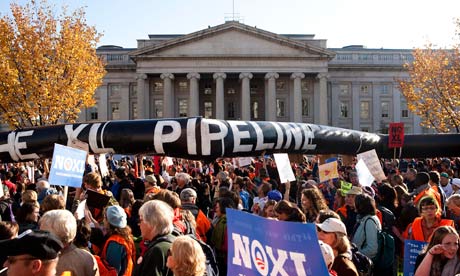
Protesters to Obama: Reject Keystone XL and Act on Climate Change
Within two weeks of President Obama's re-election, protesters gathered outside the White House to call on the president to reject the Keystone XL pipeline and to act on climate change.
The Keystone Pipeline was announced in 2005 and became operational in 2010 - transporting crude oil from Alberta, Canada, to Illinois, United States. The Keystone XL extension was then announced in 2008, which would extend the pipeline from Alberta throughout the country to the Gulf of Mexico.
The US State Department announced last year that they would wait until after the 2012 election to make a decision of whether or not to go through with the controversial project. Obama decided to put the project on hold because its construction would harm an environmentally sensitive area in Nebraska. However, for this reason, the company behind the pipeline - TransCanada - changed the route to avoid the area. Due to the new proposed route, proponents and activists alike believe that the president may now accept the project.
The protestors gathered in hope that Obama will hear their call to reject the presidential permit required for the pipeline to cross from Canada into the US. They are hoping that his acceptance speech promise to address climate change means that he will reject the pipeline.
Several environmental groups, citizens, and politicians have raised concerns about the potential adverse impacts of the Keystone XL extension. For example, there is the possibility of water and soil contamination from the 500,000 to 700,000 barrels of crude oil that would be transported via the pipeline daily. Several wildlife habitats and migratory bird routes may be affected. Several citizens may be forced to move from their homes as their land is taken for the project, requiring assistance of an eminent domain lawyer. And of course, it cannot be failed to mention that promoting fossil fuel based projects can increase green house gas emissions and climate change.
Bill McKidden, the founder of 350.org, helped organize the protest. He said that the protest was to remind the president and the administration of the activist's commitment to preventing the Keystone XL pipeline from happening. The State Department, however, does not anticipate finishing its review of the Keystone XL project before the first quarter of 2013.
The Keystone Pipeline was announced in 2005 and became operational in 2010 - transporting crude oil from Alberta, Canada, to Illinois, United States. The Keystone XL extension was then announced in 2008, which would extend the pipeline from Alberta throughout the country to the Gulf of Mexico.
The US State Department announced last year that they would wait until after the 2012 election to make a decision of whether or not to go through with the controversial project. Obama decided to put the project on hold because its construction would harm an environmentally sensitive area in Nebraska. However, for this reason, the company behind the pipeline - TransCanada - changed the route to avoid the area. Due to the new proposed route, proponents and activists alike believe that the president may now accept the project.
The protestors gathered in hope that Obama will hear their call to reject the presidential permit required for the pipeline to cross from Canada into the US. They are hoping that his acceptance speech promise to address climate change means that he will reject the pipeline.
Several environmental groups, citizens, and politicians have raised concerns about the potential adverse impacts of the Keystone XL extension. For example, there is the possibility of water and soil contamination from the 500,000 to 700,000 barrels of crude oil that would be transported via the pipeline daily. Several wildlife habitats and migratory bird routes may be affected. Several citizens may be forced to move from their homes as their land is taken for the project, requiring assistance of an eminent domain lawyer. And of course, it cannot be failed to mention that promoting fossil fuel based projects can increase green house gas emissions and climate change.
Bill McKidden, the founder of 350.org, helped organize the protest. He said that the protest was to remind the president and the administration of the activist's commitment to preventing the Keystone XL pipeline from happening. The State Department, however, does not anticipate finishing its review of the Keystone XL project before the first quarter of 2013.
Tuesday, November 13, 2012
Solar Power at San Diego State University
Solar power in San Diego State University (SDSU) is making headlines, as researchers have been able to generate solar-powered electricity using just sun and air. Sun and air may seem like the obvious ingredients needed to make solar power, but in fact, many concentrated solar power (CSP) technologies use superheated air to power a generator need water sources.
Although solar power is a great alternative to using fossil fuels - and can help reduce greenhouse gas emissions - the current method of producing solar power uses water, a non-renewable natural resource.
Current CSP systems use mirrors or lenses to concentrate a large area of sunlight (also called solar thermal energy) onto a small area that can convert the light into energy. Solar-powered electricity is produced when the light is converted to heat, which drives a heat engine - most commonly a steam turbine - connected to an electrical power generator. This turbine uses heated water to generate the steam which then powers the generator. The SDSU researchers have developed new technology to use as an alternative to water-based CSP systems. This innovation is an advancement, as the ideal location for CSP systems is in the desert.
The new CSP technology uses carbon nano particles to make the thermal absorption process in air more efficient - the light is converted into heat more effectively when it is absorbed by the nano particles. This method is more efficient when compared to the traditional method, which heats the air by pushing it through tubes. This system drives a combustion turbine as opposed to a steam turbine.
After the technology was successfully tested, plans are now in order for the system to be scaled up and put into use in the field at the National Solar Thermal Testing Facility at Sandia National Laboratory in New Mexico. The lead researcher involved in the project was awarded a grant of $3.9 million from the United States Department of Energy's (DOE) SunShot Initiative.
The DOE SunShot Initiative is a national initiative to make solar energy costs more competitive with other forms of energy by 2020.
For more information on solar energy in San Diego, visit Solaire Energy Systems.
Although solar power is a great alternative to using fossil fuels - and can help reduce greenhouse gas emissions - the current method of producing solar power uses water, a non-renewable natural resource.
Current CSP systems use mirrors or lenses to concentrate a large area of sunlight (also called solar thermal energy) onto a small area that can convert the light into energy. Solar-powered electricity is produced when the light is converted to heat, which drives a heat engine - most commonly a steam turbine - connected to an electrical power generator. This turbine uses heated water to generate the steam which then powers the generator. The SDSU researchers have developed new technology to use as an alternative to water-based CSP systems. This innovation is an advancement, as the ideal location for CSP systems is in the desert.
The new CSP technology uses carbon nano particles to make the thermal absorption process in air more efficient - the light is converted into heat more effectively when it is absorbed by the nano particles. This method is more efficient when compared to the traditional method, which heats the air by pushing it through tubes. This system drives a combustion turbine as opposed to a steam turbine.
After the technology was successfully tested, plans are now in order for the system to be scaled up and put into use in the field at the National Solar Thermal Testing Facility at Sandia National Laboratory in New Mexico. The lead researcher involved in the project was awarded a grant of $3.9 million from the United States Department of Energy's (DOE) SunShot Initiative.
The DOE SunShot Initiative is a national initiative to make solar energy costs more competitive with other forms of energy by 2020.
For more information on solar energy in San Diego, visit Solaire Energy Systems.
Subscribe to:
Posts (Atom)