Showing posts with label keystone XL. Show all posts

Wednesday, December 12, 2012

Did TransCanada Lie?

A judge has halted construction of the Keystone XL pipeline in Texas in result of the newest lawsuit that had come out of the Keystone XL debacle. A Texas resident is claiming that TransCanada, the company behind the pipe, lied to Texans when it said it would be using the Keystone XL pipeline to transport crude oil.

The pipeline will be designed to carry tar sands oil from Canada to the Gulf Coast through Texas. Although the pipe requires permission from Obama to cross country lines - which is denied last year, inter-country has begun.

As we reported earlier this month, an appeals court ruled that TransCanada could use eminent- domain law to seize land in Texas to build the Keystone XL pipeline. This left many Texans asking, "What is eminent domain?" They soon realized, however, that it meant the the state could physically take their property and hand it over to TransCanada.

One such resident, Michael Bishop, who had has land taken for the construction of the pipeline, wanted to check the validity of the taking. A Texas judge examined the plea, and ordered TransCanada to temporarily discontinue working on the private property where it has been building part of an oil pipeline for a two-week injunction.

The previous court case ruled that tar sands oil are a form of crude oil, which is a common carrier that pipelines are allowed to use eminent domain to carry. However, tar sands oil does not meet the definition as outlined in Texas and federal statutory codes which define crude oil as “liquid hydrocarbons extracted from the earth at atmospheric temperatures. When tar sands are extracted in Alberta, Canada, the material is almost a solid, and can only be in liquid form when heated and melted down.

TransCanada had not mentioned that the tar sands would be refined. This not only violates the orginal definition, but now environmentalists are concerned that if the pipeline leaks or spill occurs, the heavy tar sands will contaminate water and land - as tar sands are more difficult to clean than is regular crude oil. In addition, refining the product will further air pollution in the Gulf Coast.

Since the onset of the pipeline design, several landowners across the country - not just in Texas - have brought lawsuits to the courts to fight the company’s land condemnations. In the majority of the cases, construction has been allowed to resume despite injunctions held prior. In such cases, the landowner is awarded compensation for their land. Several times, such as for Bishop, the landowners can not afford to hire a comdemnation attorney and are forced to settle.

Monday, December 3, 2012

Keystone XL Allowed to Use Eminent Domain

An appeals court ruled that TransCanada Corp. can use eminent- domain law to seize land in Texas to build the Keystone XL pipeline.

The Keystone XL pipeline proponents hope it will transport Canadian tar-sands crude oil to Gulf Coast refineries. The Keystone Pipeline System is a pipeline system to transport synthetic crude oil from northeastern Alberta, Canada to multiple destinations in the United States, which include refineries in Illinois, Oklahoma, and proposed connections to refineries along the Gulf Coast of Texas.

One of the main issues with Keystone XL, in addition to its various environmental harms, is that the construction of the pipeline will require taking private land from landowners throughout the country, using eminent domain. Although the government will have to provide just compensation for any land taken, several landowners have hired an eminent domain lawyer to review their cases and fight against the taking. Such cases have been ongoing in Texas for the past year.

The pipeline opponents in Texas claimed that a 2011 TX Supreme Court decision withheld condemnation powers from interstate pipelines that transport out-of-state crude into Texas - only intrastate pipelines transporting hydrocarbons within state borders should be allowed to use eminent domain, the landowners and their condemnation lawyer said in court filings.

This would imply that TransCanada could not use eminent domain, as the company doesn’t meet the definition of a “common carrier” under the 2011 ruling and shouldn’t be allowed to use state eminent-domain laws to take private property. The lower court rejected the farmers’ claim, and the case moved to the appeal's court.

The appellate panel agreed and upheld the dismissal, finding that the Texas law doesn’t limit the right of eminent domain to pipelines within the state’s borders. Now, officially under Texas law, TransCanada is a common carrier and will be able to take any land needed for the construction and maintenance of the pipeline. 

TransCanada has consistently won in all lawsuits along the Keystone XL pipeline route through Texas. Thanks to the court's permission, if President Obama approves the pipeline, then TransCanada can legally start to build the southernmost leg of its 2,151-mile pipeline between western Canada and the US refining industry complex on the Texas coast. 

Monday, November 19, 2012

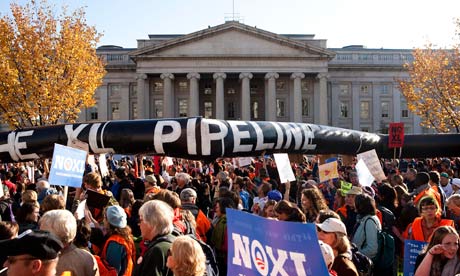
Protesters to Obama: Reject Keystone XL and Act on Climate Change

Within two weeks of President Obama's re-election, protesters gathered outside the White House to call on the president to reject the Keystone XL pipeline and to act on climate change.

The Keystone Pipeline was announced in 2005 and became operational in 2010 - transporting crude oil from Alberta, Canada, to Illinois, United States. The Keystone XL extension was then announced in 2008, which would extend the pipeline from Alberta throughout the country to the Gulf of Mexico.

The US State Department announced last year that they would wait until after the 2012 election to make a decision of whether or not to go through with the controversial project. Obama decided to put the project on hold because its construction would harm an environmentally sensitive area in Nebraska. However, for this reason, the company behind the pipeline - TransCanada - changed the route to avoid the area. Due to the new proposed route, proponents and activists alike believe that the president may now accept the project.

The protestors gathered in hope that Obama will hear their call to reject the presidential permit required for the pipeline to cross from Canada into the US. They are hoping that his acceptance speech promise to address climate change means that he will reject the pipeline.

Several environmental groups, citizens, and politicians have raised concerns about the potential adverse impacts of the Keystone XL extension. For example, there is the possibility of water and soil contamination from the 500,000 to 700,000 barrels of crude oil that would be transported via the pipeline daily. Several wildlife habitats and migratory bird routes may be affected. Several citizens may be forced to move from their homes as their land is taken for the project, requiring assistance of an eminent domain lawyer. And of course, it cannot be failed to mention that promoting fossil fuel based projects can increase green house gas emissions and climate change.

Bill McKidden, the founder of 350.org, helped organize the protest. He said that the protest was to remind the president and the administration of the activist's commitment to preventing the Keystone XL pipeline from happening. The State Department, however, does not anticipate finishing its review of the Keystone XL project before the first quarter of 2013.

Thursday, September 27, 2012

Landowners sue Nebraska governor over eminent domain use for Keystone XL


A group of landowners in Nebraska is suing their state governor in order to stop the Keystone XL pipeline project, which is being built to transport tar sands petroleum from Alberta to oil refineries in Texas.
Inside Climate News reported this group of landowners, who recently helped stop TransCanada’s plan to build through Nebraska’s environmentally-sensitive Sandhills area, have said the laws upholding pipeline construction are unconstitutional, but state officials are disregarding the suit, saying it should be thrown out because eminent domain lawyer teams representing the landowners have no right to make the challenge.
The group, led by Randy Thompson, Susan Luebbe and Susan Dunavan has challenged Nebraska's controversial "pipeline siting" law by filing a suit against Nebraska Gov. Dave Heineman, the state treasurer and the director of the Department of Environmental Quality.
According to the landowners, the pipeline siting law, which went into effect last April, allows the oil company and other energy corporations to avoid rigorous environmental assessments by working through the DEQ, and not through the state's Public Service Commission.
While TransCanada's new route avoids the fragile Sandhills ecosystem, but it still crosses the Ogallal aquifer, one of the most important water sources in the state. 
Legal experts say the State Department will have the final say on whether to approve the Keystone XL's northern leg because it crosses a national border, but Nebraska regulators are largely responsible for determining whether the pipeline's route through the state is safe to people and the environment.
The pipeline sitting law also gives Gov. Heineman, who is in complete support of the project, the ultimate authority to approve or reject the Nebraska route. The law even lets TransCanada confiscate private land for Keystone XL construction through eminent domain before the project is federally approved. 
In response, the landowners want the law declared unconstitutional for giving the governor "unlawful" authority over pipelines and their private property. But it's still unclear if the case will be allowed to proceed.
Eminent domain attorney teams working on the case from the Nebraska Attorney General's office argued that the suit should be thrown out during a hearing last September. They said landowners have no right to challenge the $2 million pipeline review process because it isn't being funded by taxpayers. 
To this day, the route of the Keystone XL and it’s ultimate fate remain unclear, but judging from the state of the legal battles in Nebraska, it seems clear that governments support the project.