Showing posts with label climate change. Show all posts

Wednesday, February 13, 2013

Solar Leases Make Residential Solar Power More Affordable

Solar leases are making residential solar energy more affordable for many homeowners across the United States.

The high, up-front cost of solar panel installation causes many people to reconsider utilizing this renewable energy source, despite the fact that it not only lessens monthly electricity bills but also reduces our carbon footprint.

However, the new option of "solar leases" are a great alternative and are expected to lead to more installations nationwide. These leases allow a homeowners to pay either very little or no money down to have solar panels installed on the roofs of their homes. The catch here is that instead of buying solar panels, the homeowner leases them from a solar lease company.

Instead of paying the sometimes massive upfront cost, homeowners pay a monthly fee for using the electricity generated by the solar panels. Homeowners would then typically sign a long-term contract (approximately 15 to 20 years) with the solar lease companies that 1) pay for solar equipment and the installation and 2) make sure the solar panels function properly and perform general maintenance.

Friday, January 25, 2013

Obama's 2nd Term Push for Climate

President Barack Obama pledged in his inaugural address Monday to respond to the threat of climate change, saying the "failure to do so would betray our children and future generations."

By singling out climate change for several lines of his speech, he is taking on an issue that he acknowledges was often overlooked during his first term and setting up a confrontation with congressional Republicans who have opposed legislative efforts to curb global warming.

Reuter's reported that Obama will renew his push to spur investment in renewable energy projects that create jobs as a key part of his second-term strategy for tackling climate change, according to a top White House policy adviser.

During his second term, Obama won't have the $90 billion in economic stimulus funds that his administration had pumped into clean energy and "green jobs" projects during the first term.  Instead, Obama wants to see "targeted and smart" investments in research and demonstration projects, and will also use the upcoming corporate tax reform process to try to "level the playing field" for renewable forms of energy, said Brian Deese, deputy director of the National Economic Council.

Obama has continued to argue that the United States cannot fall behind in a global clean energy race dominated by countries like China, South Korea and Germany, which heavily subsidize their domestic industries. "Our political system and our private sector are never going to operate in the way that some of those countries operate to strategically support targeted industries and go all-in in that way," Deese told a National Journal/The Atlantic event on energy innovation.

While Obama's inauguration words attracted a lot of attention, what came next in the speech was also important, Deese said - Obama's contention that the nation must use more "sustainable energy sources" to maintain its "economic vitality" as well as to protect the environment.

"We cannot cede to other nations the technology that will power new jobs and new industries, we must claim its promise," Obama said.

The White House is realistic about the slim chances of advancing comprehensive climate legislation in Congress, where many Republicans are staunchly opposed. Instead, Deese said the administration will look for ways to use other types of legislation to accomplish clean energy goals, including upcoming efforts to overhaul the tax code.

Obama recently pushed for an extension of the wind production tax credit and other clean energy tax credits as part of the "fiscal cliff" deal with Congress. Tax breaks for traditional fossil fuel production have long been enshrined in the U.S. tax code, Deese said. "One of the things the president has talked about is ... at a minimum, we should have a level playing field" for renewable energy.

The President also wants to explore "targeted and smart investments to help catalyze renewable energy technologies" that can lead to more U.S. manufacturing jobs, said Deese, adding that projects to make buildings become more energy efficient is another area of promise. He said Obama still would like to see Congress pass a "clean energy standard" with annual targets for electricity from clean sources that would allow utilities to decide what type of renewable power source would best fill the quota.

Obama also may take actions that don't require congressional approval or spending, such as the increase in fuel economy standards set during his first term that will cut carbon pollution and fossil fuel use dramatically over 25 years.

Monday, November 19, 2012

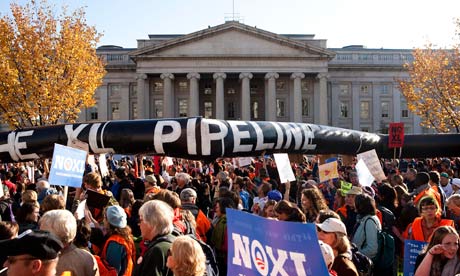
Protesters to Obama: Reject Keystone XL and Act on Climate Change

Within two weeks of President Obama's re-election, protesters gathered outside the White House to call on the president to reject the Keystone XL pipeline and to act on climate change.

The Keystone Pipeline was announced in 2005 and became operational in 2010 - transporting crude oil from Alberta, Canada, to Illinois, United States. The Keystone XL extension was then announced in 2008, which would extend the pipeline from Alberta throughout the country to the Gulf of Mexico.

The US State Department announced last year that they would wait until after the 2012 election to make a decision of whether or not to go through with the controversial project. Obama decided to put the project on hold because its construction would harm an environmentally sensitive area in Nebraska. However, for this reason, the company behind the pipeline - TransCanada - changed the route to avoid the area. Due to the new proposed route, proponents and activists alike believe that the president may now accept the project.

The protestors gathered in hope that Obama will hear their call to reject the presidential permit required for the pipeline to cross from Canada into the US. They are hoping that his acceptance speech promise to address climate change means that he will reject the pipeline.

Several environmental groups, citizens, and politicians have raised concerns about the potential adverse impacts of the Keystone XL extension. For example, there is the possibility of water and soil contamination from the 500,000 to 700,000 barrels of crude oil that would be transported via the pipeline daily. Several wildlife habitats and migratory bird routes may be affected. Several citizens may be forced to move from their homes as their land is taken for the project, requiring assistance of an eminent domain lawyer. And of course, it cannot be failed to mention that promoting fossil fuel based projects can increase green house gas emissions and climate change.

Bill McKidden, the founder of 350.org, helped organize the protest. He said that the protest was to remind the president and the administration of the activist's commitment to preventing the Keystone XL pipeline from happening. The State Department, however, does not anticipate finishing its review of the Keystone XL project before the first quarter of 2013.

Wednesday, October 31, 2012

Is Hurricane Sandy Linked to Climate Change?


Many people are questioning the links between Hurricane Sandy and climate change. Although ignored in all three presidential debates, Sandy may be an indicator that climate change should be on the minds of not just presidential candidates, but all citizens of the global world.

Hurricane Sandy, the tropical cyclone that hit the United States in late October 2012, was the largest Atlantic hurricane in diameter on record. For the Mid Atlantic and Northeast US, the damages caused by Sandy reached over $20 billion - making this hurricane the more expensive hurricane in history.

Many scientists claim that although no single weather event can prove that climate change and global warming are occurring, the known effects may have intensified the storm. There are several conditions caused by climate change that have been studied.


Global warming causes more moisture to be in the air. According to a 2011 article published in the journal Climate Research, increased global heating leads to greater amounts of moisture in the air through evapotranspiration and the water holding capacity of air increases by about 7 percent per 1°C warming. More moisture + a higher water holding capacity = more water vapor in the atmosphere. Storms supplied with more moisture thus produce more intense precipitation events, which is a common source of damage from hurricanes.

According to a 2012 publication in the journal Geophysical Research Letters, both sea level and temperature have been steadily rising since 1955. Elevated sea levels (from melting ice) can lead to more intense storm surges, and hot oceans can lead to more intense hurricanes because warm water fuels storms - relatively cooler air condenses vapor rising from water below and the heat released from the condensation gives the hurricane energy. According to the 2012 study, these changes can only be explained by the increase in atmospheric green house gases.

The world - including the presidential candidates - cannot ignore this issue for much longer. Scientists predict that the annual number of increasingly intense hurricanes will increase twofold over the next 100 years. Thanks to Sandy, climate change is starting to get some recognition. Governor Andrew Cuomo of New York City said in statements that “there has been a series of extreme weather incidents. That is not a political statement. That is a factual statement. Anyone who says there’s not a dramatic change in weather patterns, I think is denying reality.” 

So even if the hurricane onset was normal, these factors may have led to a stronger, longer storm than might have been if these conditions were absent. If true, then climate change may be setting up a world that is more hospitable to the generation of extreme weather events like hurricanes.